

Overview
Shopify is the deepest integration in Siftly Shopping. It does two jobs: it syncs your catalog in (products, variants, images, and collections) and it lets you publish back out (blog posts, Collection Pages, and optimized product data), without leaving Siftly. Difficulty: ✅ Easy. Connect in a few clicks with secure OAuth. No code, no API keys. There are two ways to connect, depending on how you found Siftly:Prerequisites
- A Shopify store
- A user with permission to install apps and approve access on that store
Connecting from Siftly (OAuth)
1
Start the connection
Go to Settings → Integrations and click Connect next to Shopify. Enter your store’s
your-store.myshopify.com domain.2
Approve access
You’ll be redirected to Shopify to review the permissions Siftly requests. Click Install to approve. You never share a password with Siftly.
3
Your catalog syncs
Shopify redirects you back to Siftly and your catalog begins syncing in the background. You’ll see a live count as products come in.
Connecting from the Shopify App Store
When you install Siftly Shopping from the App Store, Shopify sends you to Siftly to finish setup. If you aren’t signed in yet, Siftly remembers your store and claims it once you create or sign in to your organization.1
Install from the Shopify App Store
Find Siftly Shopping in the Shopify App Store and click Install.
2
Finish setup in Siftly
Shopify hands you off to Siftly. Sign in or create your organization, and Siftly automatically attaches (claims) your store to it.
3
Your catalog syncs
Once claimed, your catalog syncs in the background, just like the OAuth path.
If your store isn’t attached automatically (for example, you closed the tab mid-signup), open Settings → Integrations and finish the connection, or revisit the claim link Shopify provided.
What Siftly syncs
Sync runs in the background after connecting and refreshes as your catalog changes.
Publishing from Siftly
Once connected, Siftly can publish back to your store:- Blog posts → your Shopify blog. See Content.
- Collection Pages → Shopify collections, published to your Online Store. See Collection Pages.
- Optimized product data → submitted through Google Merchant Center and Manufacturer Center. See Product Optimization.
Permissions and reconnecting
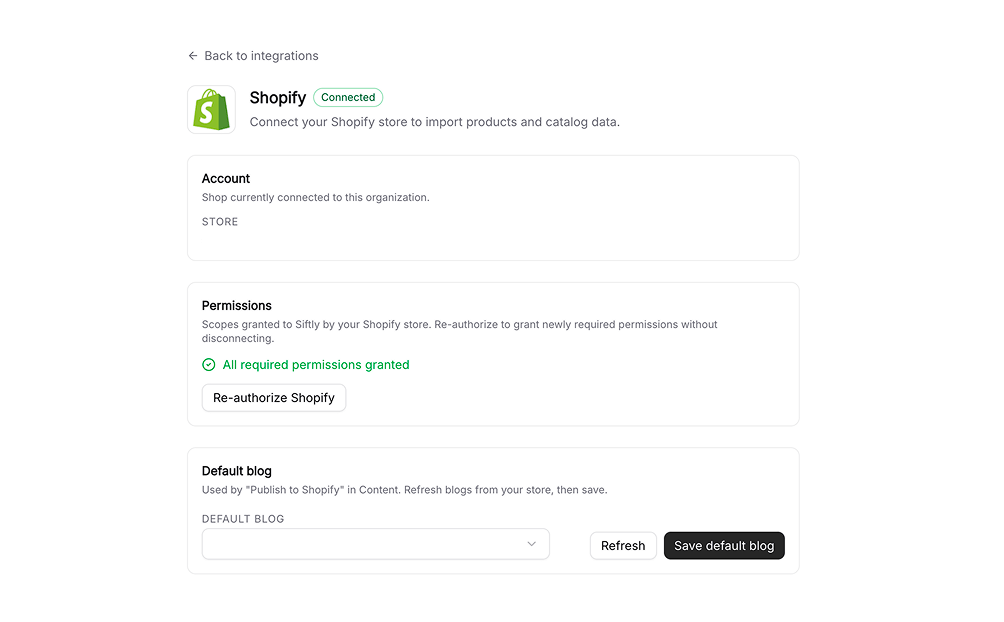
Siftly requests only the scopes it needs to sync your catalog and publish on your behalf. Occasionally Shopify introduces a new permission requirement; when that happens Siftly shows a Reconnect required prompt on the Shopify integration card. To switch stores, disconnect and reconnect with the new store’s domain.Data and privacy
Siftly honors Shopify’s mandatory privacy webhooks (customer data request, customer redact, and shop redact). When you uninstall the app from Shopify, Siftly stops syncing your store. To disconnect from Siftly: go to Settings → Integrations → Shopify and click Disconnect. This removes your stored credentials; it does not affect content already published to your store.Troubleshooting
My store wasn't attached after installing from the App Store
My store wasn't attached after installing from the App Store
Sign in to Siftly and open Settings → Integrations. If the store is pending, finish the connection there. If it still doesn’t attach, reconnect via OAuth using your
myshopify.com domain.'Reconnect required' on the Shopify card
'Reconnect required' on the Shopify card
Shopify added a permission requirement since you connected. Click Reconnect and approve the updated scopes. Publishing resumes immediately afterward.
Products aren't appearing
Products aren't appearing
The initial sync runs in the background and can take a few minutes for large catalogs. If products still don’t appear, reconnect the integration to re-trigger a sync.
Publish failed: blog or collection not found
Publish failed: blog or collection not found
Make sure your store has at least one blog (for posts) and that the integration has the scopes to write collections. Reconnect if you recently changed store settings.
Related
Integrations overview
Compare every integration and what each one powers.
Collection Pages
Generate and publish Shopify collection pages.
Content
Generate blog posts and publish them to Shopify.
Product Optimization
Optimize product data and submit it to Google.